Cordless Handpiece

Understanding the tool
A dental polishing handpiece is a motorized tool used during routine cleanings to polish teeth and remove surface stains. A motor drives a disposable polishing head while the clinician continuously grips, rotates, and repositions the handpiece around the patient’s teeth.

01 —
Polish
A low-speed motor drives a disposable polishing head used to polish tooth surfaces.
02 —
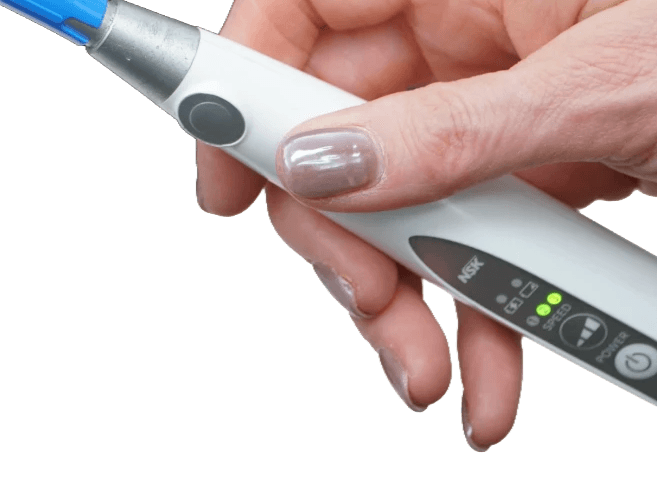
Control
The clinician continuously grips, rotates, and repositions the handpiece throughout the procedure.

03 —
Improve
This project explores a cordless system designed to reduce cable interference, improve ergonomics, simplify controls, and create a more fluid chairside workflow.
Clinical Insights
Interview with Dr. Melissa Meier
A clinical interview highlighted three opportunities for improving the cordless polishing experience: reducing ergonomic strain, simplifying control placement, and making the charging workflow more useful.

01 — Reduce strain
Repetitive procedures make hand comfort critical.
Design response
Support a comfortable grip and natural wrist rotation.
02 — Simplify control
Awkward control placement can interrupt routine procedures and require unnecessary hand repositioning.
Design response
Keep primary controls accessible without changing grip.
03 — Improve the dock
Charging docks typically provide little functionality beyond power.
Design response
Explore preset RPM controls and tool-status feedback as part of the charging system.
Task analysis
01 / Remove from dock
Tool is removed from the charging dock and brought into position for the procedure.
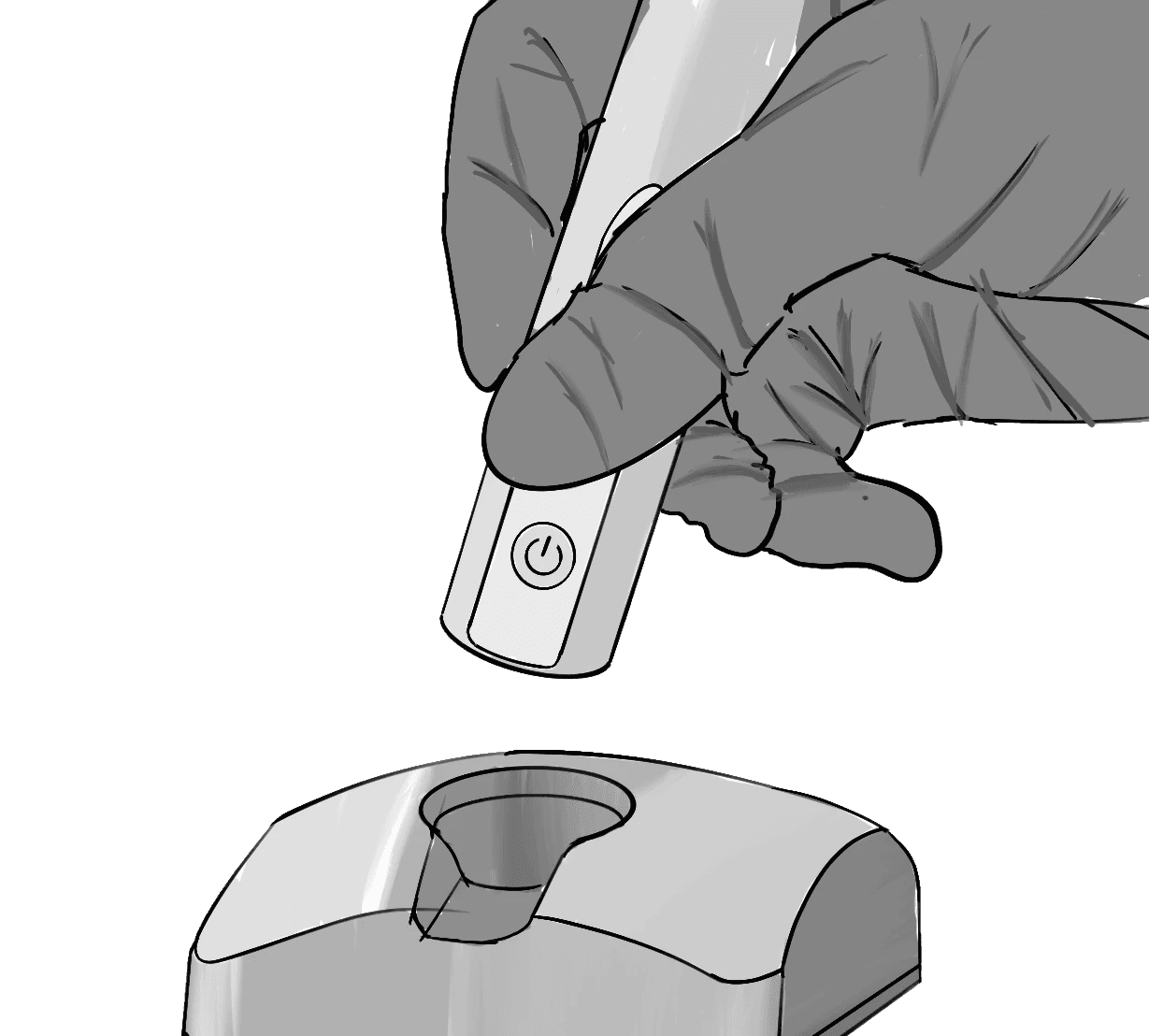
DESIGN OPPORTUNITY
Make pickup, status, and readiness immediately understandable.
02 / Install tip
A disposable polishing tip is installed and positioned before patient-side use.

DESIGN OPPORTUNITY
Maintain compatibility with familiar disposable polishing heads.
03 / Set speed
Tool is powered on and polishing speed is adjusted with the handpiece controls.

DESIGN OPPORTUNITY
Keep primary controls accessible without requiring a change in grip.
04 / Polish teeth
Teeth polishing is performed with repeated wrist and grip adjustments around the mouth.

DESIGN OPPORTUNITY
Support repeated wrist rotation while minimizing grip strain.
05 / Wipe down & recharge
The tool is wiped down, returned to the dock, and prepared for the next patient.
DESIGN OPPORTUNITY
Use the dock for charging, status feedback, and procedure setup.

Research & insights
Insights focus on repetitive grip fatigue, interruption caused by cords, and the need for controls that can be understood without looking away from the patient.
Ergonomics
A cordless form can reduce cable drag and support a more neutral wrist angle during repeated polishing motions.
Workflow
Removing the cord simplifies tray setup, patient repositioning, and transitions.
Controls
A simplified control interface helps clinicians adjust speed and confirm battery status without breaking concentration.
Competitive analysis
Maped existing prophy systems by cord management, control, handpiece weight, and perceived clinical precision to find opportunities for a more integrated cordless tool.
Comfort vs. Weight
Lower weight and higher comfort are ideal
Runtime vs. Charging
Long runtime weight and fast charging is ideal


Cordless freedom
Existing products solve power delivery but still tether movement. A cordless handpiece reframes the tool around clinician mobility.
Visible feedback
Battery and speed states should be readable at a glance so the tool feels dependable in a clinical environment.
Controlled touchpoints
Grip, buttons, and polishing-head transitions become the main cues for confidence, hygiene, and precision.


Goal Design language
Friendly / Technical / Controlled
The form language balances approachable soft transitions with crisp functional boundaries. The handpiece should read as clean and precise without feeling cold or intimidating.
Ideation
A sketch-heavy phase explored how the tool should sit in the hand, where control surfaces belong, and how the polishing head transitions into the body.

Stage 2 Ideation

Ergonomic development
Mockups tested diameter, balance, index placement, and wrist-roll support to keep the tool controlled during repetitive polishing motions.
01 / Physical ergonomic studies


Quick physical models tested grip diameter, handle length, and wrist rotation before committing to form
02 / Secondary studies


proportions were translated into CAD to refine grip transitions, control placement, and wrist-roll support
03 / Finalizing concepts


Final directions were evaluated for internal component placement to balance ergonomics with mechanical design
Final form development

Refined Ergonomics
Wrist-roll support and grip transitions were refined for controlled repetitive movement.
Resolved Architecture
Final proportions balance ergonomics, control placement, and internal component packaging.
Engineering & systems
The internal architecture organizes battery, motor, controls, and polishing-head interface into a compact handpiece volume.

CAD development
Fusion 360 development translated ergonomic volumes into manufacturable surfaces, internal packaging, and detail transitions.


Final system


3 Speed Presets
1,000 · 2,000 · 3,000 RPM
Quick tactile speed selection from the dock.
Drop-In Charging
Returns to the dock to charge and stay ready between procedures.


Ergonomic control
The contoured body and wrist-roll indent support controlled rotation while keeping the primary control accessible without repositioning the hand.
Speed + status
The charging dock gives the handpiece a defined storage position while integrating charging and speed buttons into the clinical workflow.